
Christopher Burke
Senior Advisor, WMC Africa
From Southern Africa’s established cane belts to expanding sugar industries elsewhere on the continent, fertiliser volatility is becoming a strategic risk to cane supply, out grower incomes and mill performance. The regional footprint of ABF Sugar spanning Malawi, Zambia, Eswatini, South Africa, Tanzania and Rwanda Somdia through west and central Africa including Côte d’Ivoire, Cameroon, Chad and the Republic of Congo reveal how tightly connected Africa’s major cane industries have become. The cost and availability of the nutrients feeding these fields are shaped by natural-gas prices, international phosphate and potash markets, shipping routes, foreign-exchange availability and geopolitical decisions made far beyond the continent.
This exposure matters. Many producers are already under pressure. South Africa’s sugar industry directly and indirectly supports over 300,000 jobs and includes nearly 26,000 small-scale farmers, alongside approximately 1,100 large-scale growers. Recent market pressures have included cheaper imports, weaker world prices and reduced access to premium export markets. Global sugar prices have fallen to around five-year lows amid abundant supply and slower consumption growth. Soft-drink taxes and the growing use of GLP-1 weight-loss drugs are among the factors slowing demand in the United States and Western Europe while consumption continues to rise in Africa and Asia. The margin for error narrows rapidly as selling prices weaken while fertiliser, fuel and finance become more expensive.
The latest fertiliser shock has exposed vulnerabilities impossible to ignore. The World Bank projected a 31 per cent rise in its global fertiliser price index in 2026, driven by an estimated 60 per cent increase in urea prices as energy and shipping disruption spread from the Middle East into agricultural markets. Urea is manufactured from ammonia produced mainly using natural gas. Disruptions to gas and ammonia supplies quickly affect crop-production costs. The Gulf crisis interrupted global urea and ammonia flows during important planting windows in several major agricultural markets.
This is not a short-term inconvenience for sugarcane. Cane is a long-duration crop and inadequate nutrition can reduce plant-cane establishment, stalk growth, cane tonnage and the performance of later ratoons. A mill may have modern equipment, spare crushing capacity and strong market demand, but none of those assets can compensate for an unreliable flow of quality cane. Fertiliser security is not only a purchasing issue, but a question of mill utilisation, grower viability and industrial resilience.
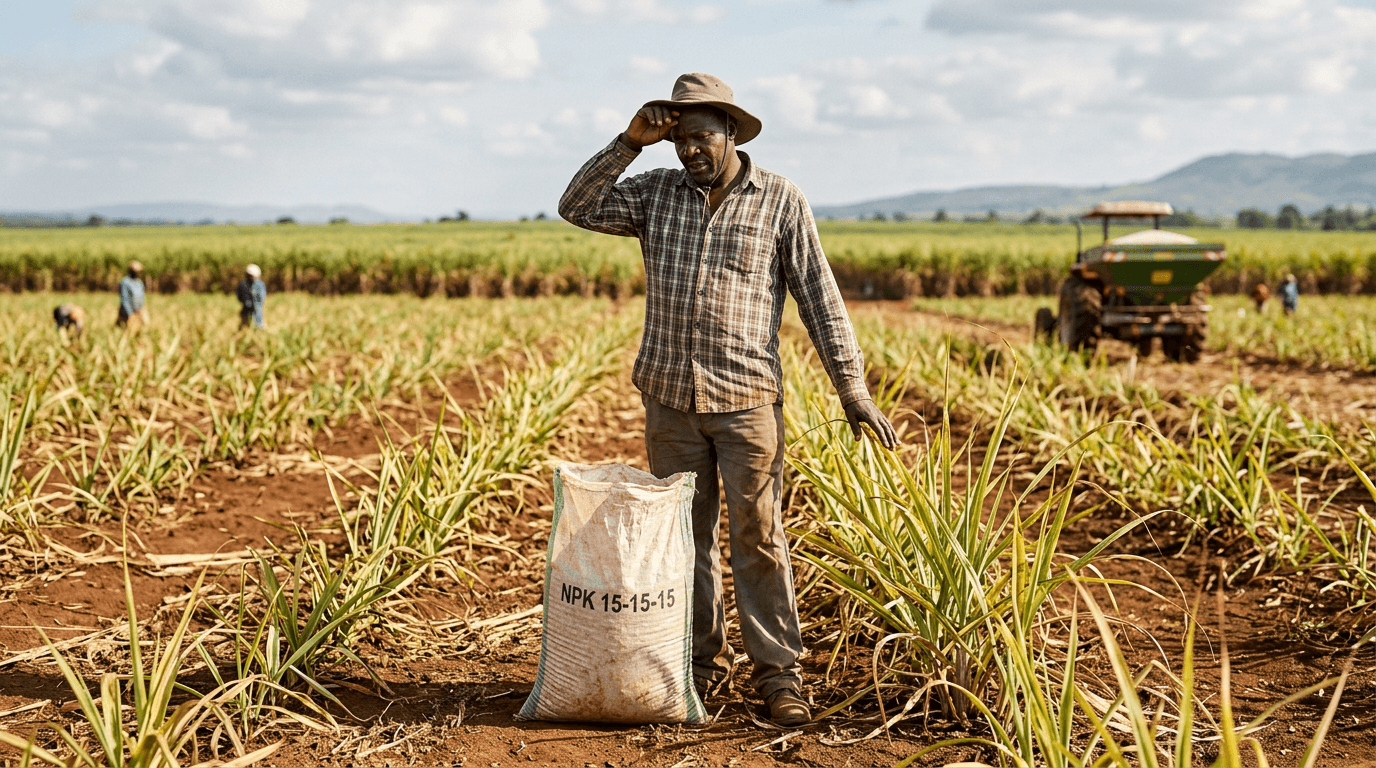
Applying more fertiliser indiscriminately is not the answer. Sugarcane requires a balanced nutrient supply that often includes substantial nitrogen and potassium, supported by phosphorus, sulphur, calcium and magnesium, with micronutrients added where soil or leaf analysis identifies deficiencies. Soil tests, leaf analysis, realistic yield targets and local field trials should guide nutrient rates, sources and timing. One standard NPK formula cannot be optimal across irrigated estates, rain-fed out grower fields, acidic soils and successive ratoons. The right question is not how many bags were distributed, but if the right nutrients reached the right fields at the right time.
This distinction reflects the wider African shift from fertiliser volume to soil health. The 2024 Nairobi Declaration commits African governments to triple domestic production and the distribution of certified-quality organic and inorganic fertilisers by 2034, make targeted agronomic recommendations available to at least 70 per cent of smallholder farmers, and restore soil health on at least 30 per cent of degraded soils. For the sugar industry, this involves combining mineral nutrition with pH correction, organic matter, residue management and better water use. Filter cake, also known as press mud, composted residues and other mill by-products can contribute to soil improvement, but they should be analysed and applied as part of a measured nutrient programme, not treated as automatic substitutes for mineral fertiliser.
The first practical response is to improve procurement. Companies can forecast demand from annual cane-development plans, tender earlier, combine estate and out grower requirements, qualify more than one supplier and maintain reasonable stocks of critical products. The aim is not to tie up excessive capital in warehouses, but to reduce last-minute purchasing when prices are highest and supply is tightest. Recent urea volatility underscores the cost of waiting until a crisis is already under way. Procurement is also increasingly shaped by buyer requirements, lender covenants, insurer due diligence and certification systems such as Bonsucro. Once auditable evidence on nutrient use, soil management or emissions becomes a condition of finance, insurance or market access, formally voluntary expectations can directly shape how companies and growers operate.
The second response is precision. Block-level soil sampling, periodic leaf analysis and separate programmes for plant cane and ratoons can help companies target expensive nutrients more effectively. Field trials should compare not only crop appearance or tonnes of cane per hectare, but recoverable sugar, ratoon performance and profit after input costs. Comparable, auditable evidence also gives companies, financiers and buyers a shared basis for evaluating risk across different jurisdictions. When fertiliser becomes more expensive, precision becomes more valuable.
The third response is to integrate out growers into the strategy. Mills across Africa depend on thousands of independent growers who often face high financing and delivery costs. Timely access to genuine products, clear recommendations, extension support and transparent repayment through cane payments can protect both farmer income and mill supply. Compost, filter cake and biofertilisers may help reduce exposure to imported inputs in suitable farming systems. These alternatives can be most effective when their nutrient content is tested and they are integrated with, not detached from, crop requirements.
African sugar producers cannot control global gas prices, shipping lanes or conflict. They can control how exposed their cane supply remains. Companies that forecast nutrient demand early, understand their soils, support out growers, measure returns in recoverable sugar and demonstrate performance through credible data will be better placed to withstand the next shock. Fertiliser security should be treated as a core component of Africa’s sugar strategy, not merely a seasonal purchase.
END
Christopher Burke is a senior advisor at WMC Africa, a communications and advisory agency located in Kampala, Uganda. With over 30 years of experience, he has worked extensively on social, political and economic development issues focused on governance, agriculture, environmental issues, extractives, policy formulation, communications, advocacy, conflict transformation, international relations and peace-building in Asia and Africa.